Petrol Up 45% Since June: Annual Fuel Cost by State
TL;DR
Charged overnight at home on an EV tariff, a mid-size electric SUV costs about 1.5 cents per kilometre in NSW, Victoria, Queensland and South Australia, or $1.52 per 100 km. The same car on a standard flat tariff costs 5 to 8 cents per kilometre depending on the state. A Toyota RAV4 Hybrid, the most efficient petrol comparison we have, costs 10.9 to 11.9 cents per kilometre at late October 2026 fuel prices, depending on the state. Public fast charging is the one place an EV gets close to petrol, at about 13.7 cents per kilometre. Over a typical year of driving, that is roughly $180 in electricity against $1,370 in petrol in NSW.
"How much does an electric car cost per km" sounds like one question. It is really three, because the answer depends on where you charge, what tariff you are on, and which state's electricity price applies. Most figures you will find online pick one answer and quietly drop the other two. This post gives you all of them, and it uses the same method as our state-by-state running cost pages, so the numbers here match what the comparison tool shows.
How the figure is worked out
An EV's rated consumption is not what you pay for. Two adjustments sit between the brochure and your bill:
- Real-world driving. The Australian Automobile Association's on-road testing found battery EVs use about 12% more energy than their rated figure. We apply that uplift to every EV number.
- Charging losses. Some of the electricity that passes your meter never reaches the battery. Home AC charging is roughly 88% efficient, so we divide by that too.
For a mid-size electric SUV, the segment that includes the Tesla Model Y, BYD Sealion 7 and Kia EV5, the catalogue's rated 14.9 kWh per 100 km becomes about 19.0 kWh measured at the meter. That is the figure every cost below is built on. The petrol comparisons use the AAA's measured on-road consumption too, not the laboratory figure, so both sides get the same treatment.
The distance is 12,100 km a year, the average from the ABS survey of motor vehicle use. It scales both sides equally, so a higher or lower figure changes the dollars but not the ratio.
The cost per kilometre, state by state
The overnight column is a retailer EV plan where one exists and the regulated off-peak rate where none does. The flat column is each state's default market offer or standing offer in the capital city distribution zone. Petrol is the RAV4 Hybrid at the state's unleaded 91 price on 27 October 2026.
| State | Overnight EV plan | Flat tariff | Public fast charger | RAV4 Hybrid |
|---|---|---|---|---|
| NSW | 1.5c | 6.3c | 13.7c | 11.4c |
| Victoria | 1.5c | 4.9c | 13.7c | 11.3c |
| Queensland | 1.5c | 5.3c | 13.7c | 11.4c |
| South Australia | 1.5c | 8.0c | 13.7c | 10.9c |
| Western Australia | 3.8c | 6.3c | 13.7c | 10.9c |
| Tasmania | 3.2c | 5.3c | 13.7c | 11.9c |
| ACT | 5.7c | 7.0c | 13.7c | 11.8c |
| Northern Territory | 6.3c | 6.0c | 13.7c | 11.8c |
Cents per kilometre, mid-size electric SUV, 12,100 km a year. Multiply by 100 for the cost per 100 km: 1.5 cents per km is $1.52 per 100 km, and 11.4 cents is $11.36.
Three things stand out.
The overnight EV plan is the whole story in the four big states. AGL's Night Saver EV plan charges 8 cents per kilowatt hour between midnight and 6am in NSW, Victoria, Queensland and South Australia, which is why all four land on the same 1.5 cents per kilometre. Cheaper plans exist, some at 4.5 to 6 cents, and we deliberately did not use them. If you charge overnight on a plan like this, an EV costs about a seventh of what a hybrid costs to move, or less where petrol is dearer.
The flat tariff still wins, but by less. On the default offer, without any EV plan, the mid-size SUV costs 4.9 to 8.0 cents per kilometre. That still beats the most efficient hybrid on sale, but South Australia's 41.9 cents per kilowatt hour narrows the gap to about 3.0 cents.
The Northern Territory is the exception to everything. Its time-of-use tariff prices the middle of the day below every other hour, so overnight charging is the dearest home option there and the flat tariff is cheaper. Our NT page defaults to the flat rate for that reason. If you are in Darwin with solar, charge at lunchtime.
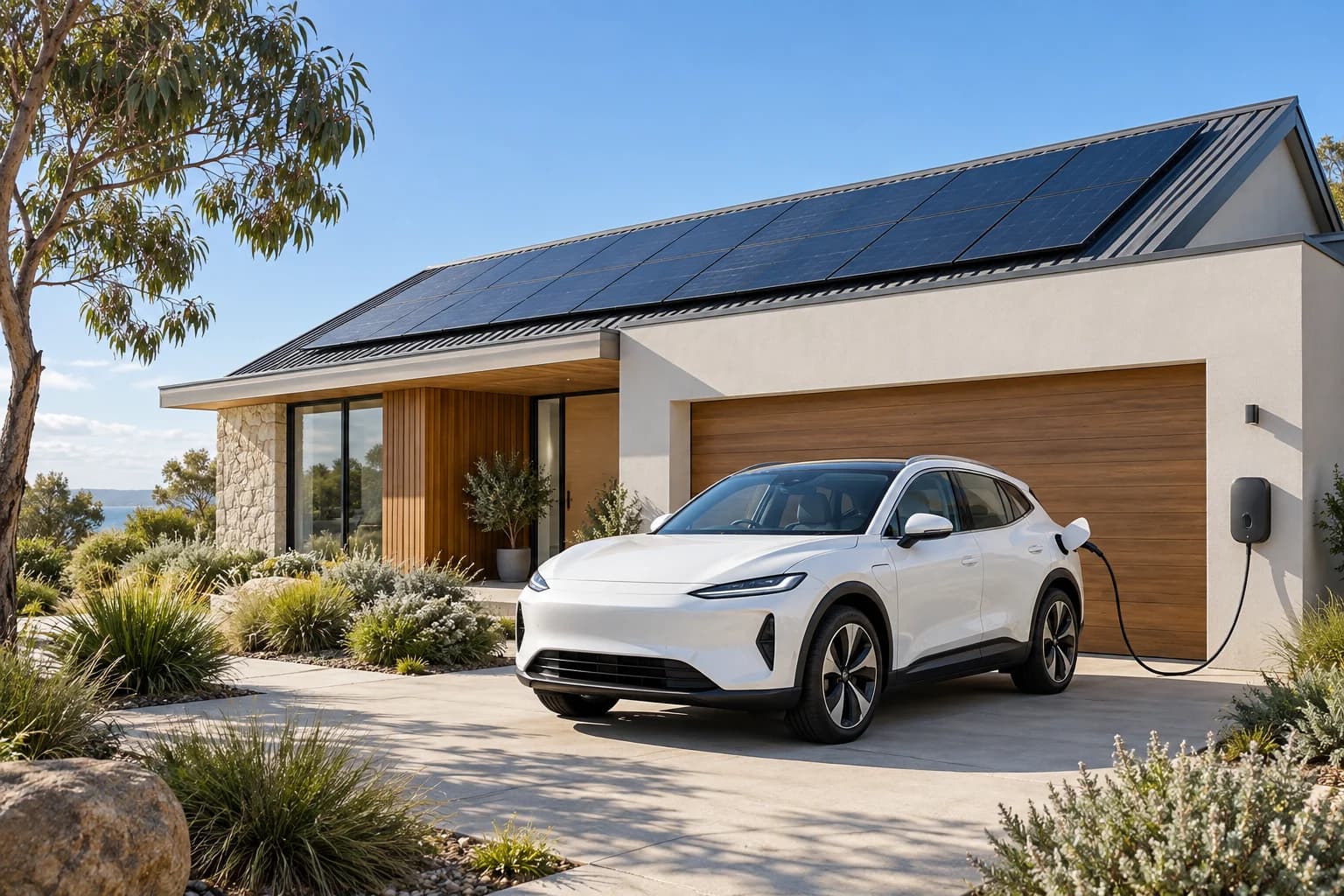
Solar and public charging, the two ends of the range
Solar. If you charge from your own panels during the day, the cost is the feed-in tariff you give up, not the retail rate. That is 0.3 to 1.8 cents per kilometre depending on the state, effectively free. It only works if the car is home during the day.
Public DC fast charging. Chargefox's casual rate on a 150 to 240 kW charger is 72 cents per kilowatt hour, which works out to 13.7 cents per kilometre. That is more than the RAV4 Hybrid in every state and well under a conventional petrol RAV4 at 16.1 cents in NSW. Fast charging is priced for convenience, not economy. An EV that relies on it for most of its charging is not cheaper to run than an efficient hybrid, which is the honest caveat to every "EVs cost nothing to run" claim.
Does the size of the car change it?
Less than you would think. In NSW on the overnight plan, every segment lands between 1.4 and 1.8 cents per kilometre:
| Segment | Overnight | Flat tariff | Petrol comparison |
|---|---|---|---|
| Electric hatchback | 1.4c | 5.7c | 9.9c (Corolla Hybrid) |
| Small electric SUV | 1.5c | 6.1c | 16.3c (Hyundai Kona) |
| Electric sedan | 1.5c | 6.1c | 11.4c (Camry Hybrid) |
| Mid-size electric SUV | 1.5c | 6.3c | 11.4c (RAV4 Hybrid) |
| Large electric SUV | 1.8c | 7.3c | 14.2c (Kia Sorento) |
Where a segment has a hybrid rival, the petrol column uses it, because comparing an EV with the thirstiest petrol car in its class flatters the EV. Where it does not, the comparator is a mainstream petrol model. Either way, the EV's energy cost is a fraction of the fuel cost at home and roughly level with it at a fast charger.
What this means in dollars a year
Take the mid-size SUV in NSW over 12,100 km:
- Overnight EV plan: about $184 a year
- Flat tariff: about $760 a year
- RAV4 Hybrid on petrol: about $1,375 a year
- Conventional petrol RAV4: about $1,948 a year
The gap between the EV on an overnight plan and the hybrid is about $1,200 a year. Over a five-year lease, that is about $6,000 in fuel alone, before the tax treatment enters the picture. On a novated lease the running costs, including electricity, can be packaged from pre-tax salary for an FBT-exempt EV, which is where the larger saving actually comes from.
What is not in these numbers
The road user charge is excluded, and it matters. NSW has legislated a distance-based charge of 3.095 cents a kilometre on battery EVs, not collected today, starting from 1 July 2027 or when EVs reach 30% of new car sales, whichever comes first. Victoria's version was struck down by the High Court in 2023 as an unconstitutional excise, and NSW is still assessing what that means for its scheme. If it starts as legislated, it would add about $375 a year at 12,100 km, taking the NSW overnight figure from 1.5 to about 4.6 cents per kilometre: still under half the hybrid, but no longer a rounding error. The state pages show the charge separately for that reason.
Tyres, servicing, insurance and depreciation are also outside a cost-per-kilometre figure. They belong in a total cost of ownership comparison, which is what the does for the car you are actually looking at.
Check your own state and car
The figures above are for one segment and one distance. The running costs comparison lets you pick your state, the segment or a specific EV from the catalogue, the petrol car you would otherwise buy, your charging setup and your annual kilometres, and it shows the sources for every rate it uses.
Electricity prices are the regulated offers effective 1 July 2026, fuel prices were checked on 27 October 2026, after a sharp rise since June (the AIP's five capital city average was 234.8 cents a litre in the week to 25 October, up from 155.4 in late June), and consumption figures come from the AAA's real-world testing program. This is general information, not financial advice. Your tariff, your driving and your charger will move the result, which is exactly why the tool lets you change them.
Illustrations of home EV charging.